


GlobalCORRIDOR is a five-year ERC Horizon 2020 project examining how emerging infrastructural geographies—especially large-scale corridor investments—are reshaping contemporary urbanization and producing new forms of techno-social inequality. The project investigates how these inequalities are experienced, navigated, and potentially addressed in everyday urban life. Working across rapidly transforming cities, GlobalCORRIDOR offers the first comprehensive social-science study of Corridor Urbanization and its impacts on sustainability and urban justice. Research is conducted through partnerships with Karachi Urban Lab, IBA (Pakistan), the British Institute of East Africa (Kenya), Crete University (Greece), the American University of Cairo (Egypt), and Politecnico di Torino (Italy). Teams of research assistants and creative collaborators have been recruited in Pakistan, Greece, and Kenya.Fieldwork is underway across a wide range of case-study sites including Lahore, Karachi, Gwadar, Faisalabad, Tharparkar, Mbale, Lamu, Mombasa, Naivasha, Nairobi, Hoima, Kampala, Athens, and Crete, along with the infrastructure systems linking them.
Objectives
The Karachi Coastal Comprehensive Development Zone (KCCDZ) is a multi-billion-dollar development proposal funded by the China-Pakistan Economic Corridor (CPEC) that seeks to transform Karachi’s backwater coast through large-scale land reclamation, new maritime infrastructure, and high-end residential and commercial districts. This project investigates the shifting visions, governance arrangements, and environmental and social implications of the KCCDZ, examining how such mega-developments reshape coastal ecologies and the lives of communities along the city’s shoreline.
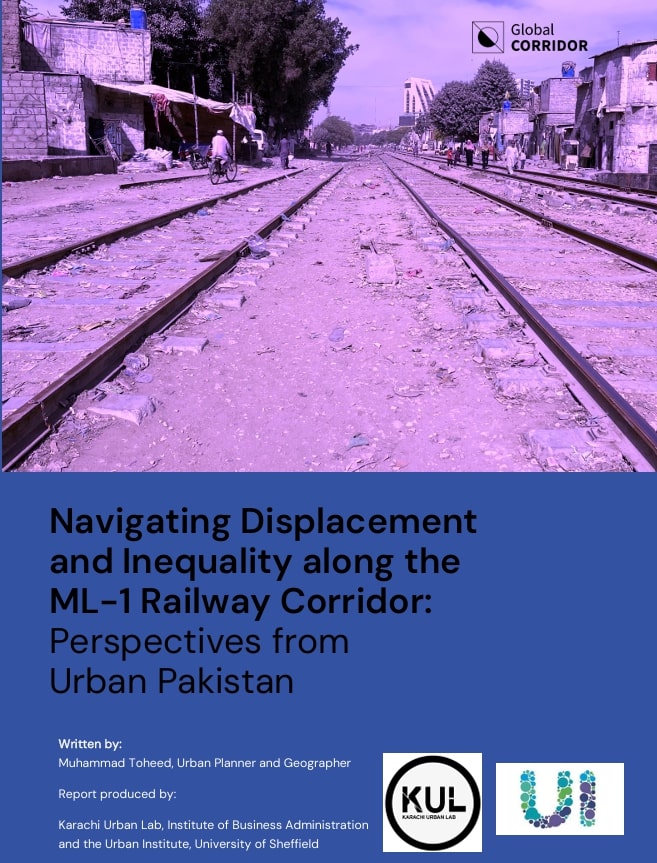
In the realm of mega infrastructure projects, the human costs of development often find itself overshadowed, leaving households in a state of uncertainty and displacement. The Mainline-1 (ML-1) China-Pakistan Economic Corridor (CPEC) project is no exception, echoing the histories of prior initiatives across Pakistan. From the Neelum Jhelum Hydro-Electric Project to the Karachi Circular Railway, the stories resonate with a common thread: the marginalization of the very individuals whose lives are irrevocably altered by such ambitious undertakings. In examining the intricacies of the ML-1 project, this report aims to illuminate the human costs intertwined with its development—the dislocation of communities, the erosion of livelihoods, and the pervasive absence of adequate resettlement frameworks. It is imperative to confront the realities faced by those displaced or left in limbo, as their struggles often become collateral damage in the pursuit of progress. In shedding light on these issues, we seek to advocate for a more inclusive approach to development—one that prioritizes the rights and dignity of affected populations, ensuring that they are not mere footnotes in the annals of infrastructural advancement.
Plans for developing the ML-1 Train line project remain uncertain. Shabnam, who built her home three years ago, and Ayesha, whose third generation now lives by the railway track, share their experiences. They talk about the troubles, uncertainty, and stress that come along with living by rail. Mehboob Illahi and Abdul Ghaffar's ongoing efforts to mobilize and create awareness among the affectees continue through the formation of the ML-1 Mutasereen Action Committee.